As an Amazon Associate, I earn from qualifying purchases. This post may contain affiliate links. If you click and buy through these links, I may earn a small commission at no extra cost to you.
1. Quick Answer
For many Indian households, a 750W mixer grinder can be a practical all-round choice for everyday chutney, masala, pastes and moderate grinding tasks. A 1000W model may be worth considering if you regularly handle heavier workloads, harder ingredients or larger batches that the specific appliance is designed to support.
That does not mean 1000W is automatically better.
Grinding results depend on several factors, including jar design, blade configuration, batch size, ingredient type and the appliance’s intended workload. The right choice is therefore the wattage that matches how you actually cook.
If you’re already comparing lower-powered options, our 500W vs 750W Mixer Grinder guide covers that range in more detail.
2. 750W vs 1000W: At a Glance
| Feature | 750W | 1000W |
| Everyday Indian cooking | Well suited to many households | More power than some everyday tasks require |
| Chutney | Suitable for small to medium batches | Suitable, depending on jar and batch size |
| Dry masala | Suitable for regular home quantities | May offer more headroom for demanding workloads |
| Wet masala | Generally suitable for household batches | Useful when workload or batch size is higher |
| Batter | Suitable for moderate quantities on suitable models | Some models are designed for heavier batter workloads |
| Larger workloads | May require smaller or multiple batches | Can be useful where the model supports larger workloads |
| Small kitchen | Often a practical choice | Check size and whether the extra power is actually needed |
| Best reason to choose it | Everyday versatility | Higher workload or more demanding use |
There is no universal winner. The specific mixer grinder matters as much as its wattage.
3. What Does Mixer Grinder Wattage Actually Mean?
Wattage indicates the motor’s rated electrical power. It gives you an idea of the motor’s power capacity, but it is not a direct measure of grinding quality.
A 1000W motor has a higher rated power than a 750W motor. That can be useful in situations where the appliance is designed to handle more demanding workloads.
But the wattage number does not tell you everything.
Jar geometry, blade design, ingredient quantity and the way ingredients move inside the jar can all affect grinding results. Two mixer grinders with the same wattage can therefore behave differently.
That’s why you should consider the complete appliance rather than choosing solely by the largest wattage number.
For the lower end of this comparison, see our 500W vs 750W Mixer Grinder guide.
4. 750W Mixer Grinder: Who Is It For?
A 750W mixer grinder can suit a wide range of everyday Indian cooking tasks.
It can be worth considering if you regularly prepare:
- Coconut chutney
- Dry spices
- Wet masala
- Ginger-garlic paste
- Everyday pastes
- Moderate quantities of batter
For a bachelor, couple or small family, 750W can often provide a useful balance between capability and practical everyday use.
However, don’t assume every 750W mixer grinder performs identically. Jar size, blade configuration, motor construction and manufacturer recommendations can make a significant difference.
When 750W makes sense
Choose a suitable 750W model when your cooking involves regular household quantities rather than frequent heavy-duty grinding.
5. 1000W Mixer Grinder: Who Is It For?
A 1000W mixer grinder may make more sense when the workload is genuinely higher.
Examples include:
- Frequent dry grinding
- Larger batches, where the jar supports them
- Harder ingredients
- Repeated grinding sessions
- Regular batter preparation in larger quantities
The key word is may.
A 1000W motor alone does not guarantee better grinding than a well-designed 750W mixer grinder. The jar, blades, motor construction and recommended workload all matter.
If your cooking requirements are modest, buying 1000W simply because it has a bigger number may not provide a meaningful advantage.
6. 750W vs 1000W for Indian Cooking
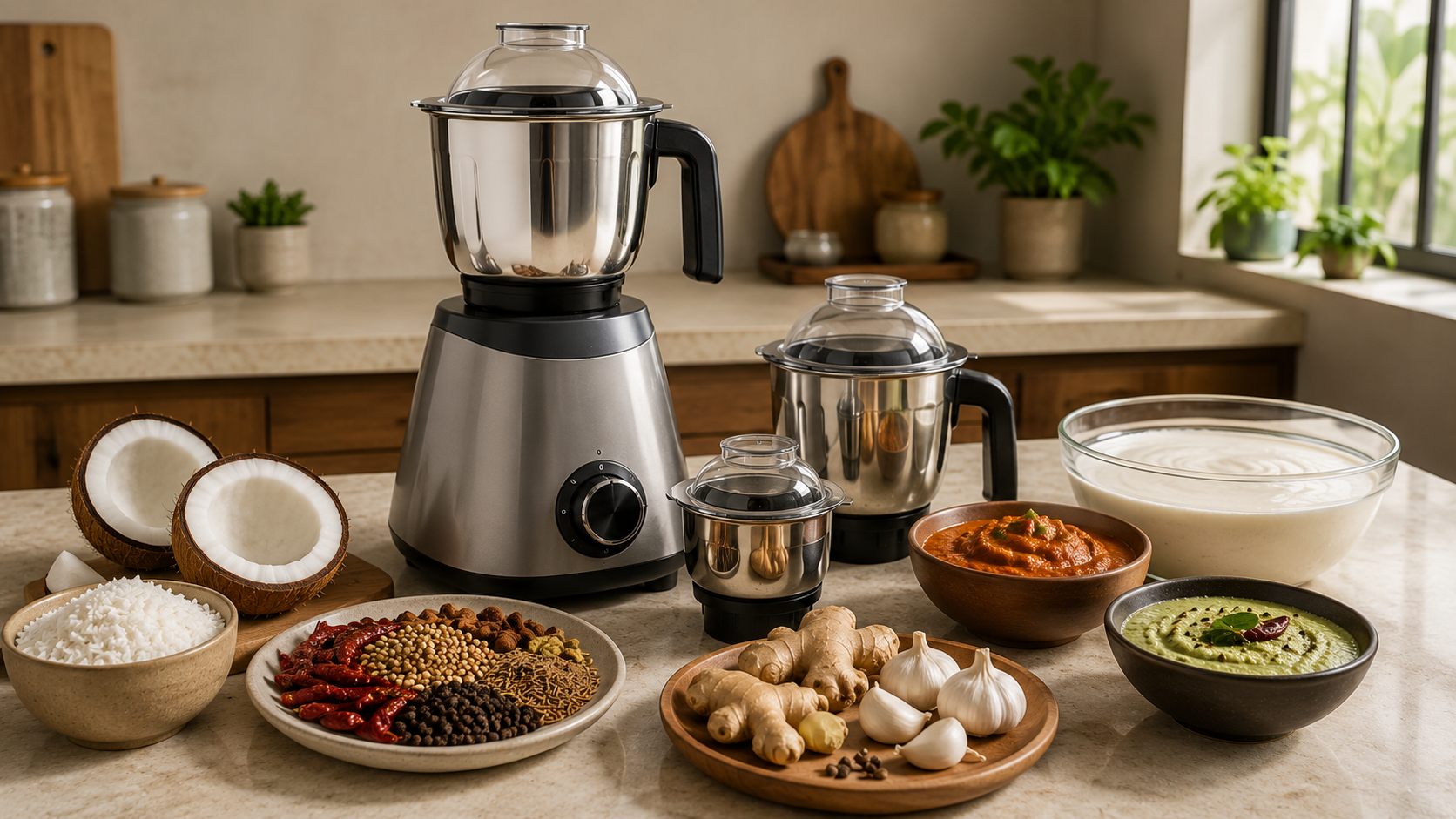
Coconut Chutney
For a normal household batch of coconut chutney, jar size and batch quantity are important considerations.
A suitable chutney jar on a 750W mixer grinder can be perfectly practical for everyday use. A 1000W model can also handle the task, but the additional motor rating may not be necessary for a small batch.
The better question is whether the jar is appropriately sized for the amount you usually prepare.
Dry Masala and Spices
Dry grinding can be more demanding when you’re processing hard or dense ingredients.
A 1000W model with a suitable dry-grinding jar may offer additional power capacity for frequent or demanding workloads. At the same time, a well-designed 750W model can be suitable for normal household quantities.
Don’t compare wattage alone. Check the dry jar, blade configuration and manufacturer recommendations.
For a more detailed guide, see Best Mixer Grinder for Dry Masala & Spice Grinding.
Ginger-Garlic Paste
Ginger and garlic are relatively soft ingredients compared with many dry spices.
For this task, a suitably sized small jar can be more important than choosing a 1000W motor.
If you mainly buy a mixer grinder for small-batch ginger-garlic paste, there is usually little reason to select 1000W solely for this task.
Wet Masala
Wet masala requirements vary significantly between households.
If you prepare small quantities for everyday meals, a suitable 750W model may be enough.
For larger or thicker batches, a 1000W model may be worth considering if its jar capacity and manufacturer specifications support that workload.
Idli & Dosa Batter
Batter preparation can involve larger quantities and longer grinding sessions.
Some 1000W mixer grinders are designed around heavier wet-grinding workloads, while suitable 750W models can work well for moderate quantities.
If batter is one of your main reasons for buying a mixer grinder, look at jar capacity and the manufacturer’s recommended operating pattern, not just wattage.
For a dedicated comparison, see Best Mixer Grinder for Idli & Dosa Batter.
Smoothies and Liquid Recipes
For smoothies and other liquid-heavy preparations, jar shape and blade configuration are important.
A blender may also be more convenient for certain liquid-heavy recipes, depending on what you prepare most often.
Our Mixer Grinder vs Blender comparison can help if you’re deciding between the two appliance types.
7. 750W vs 1000W for Different Household Sizes
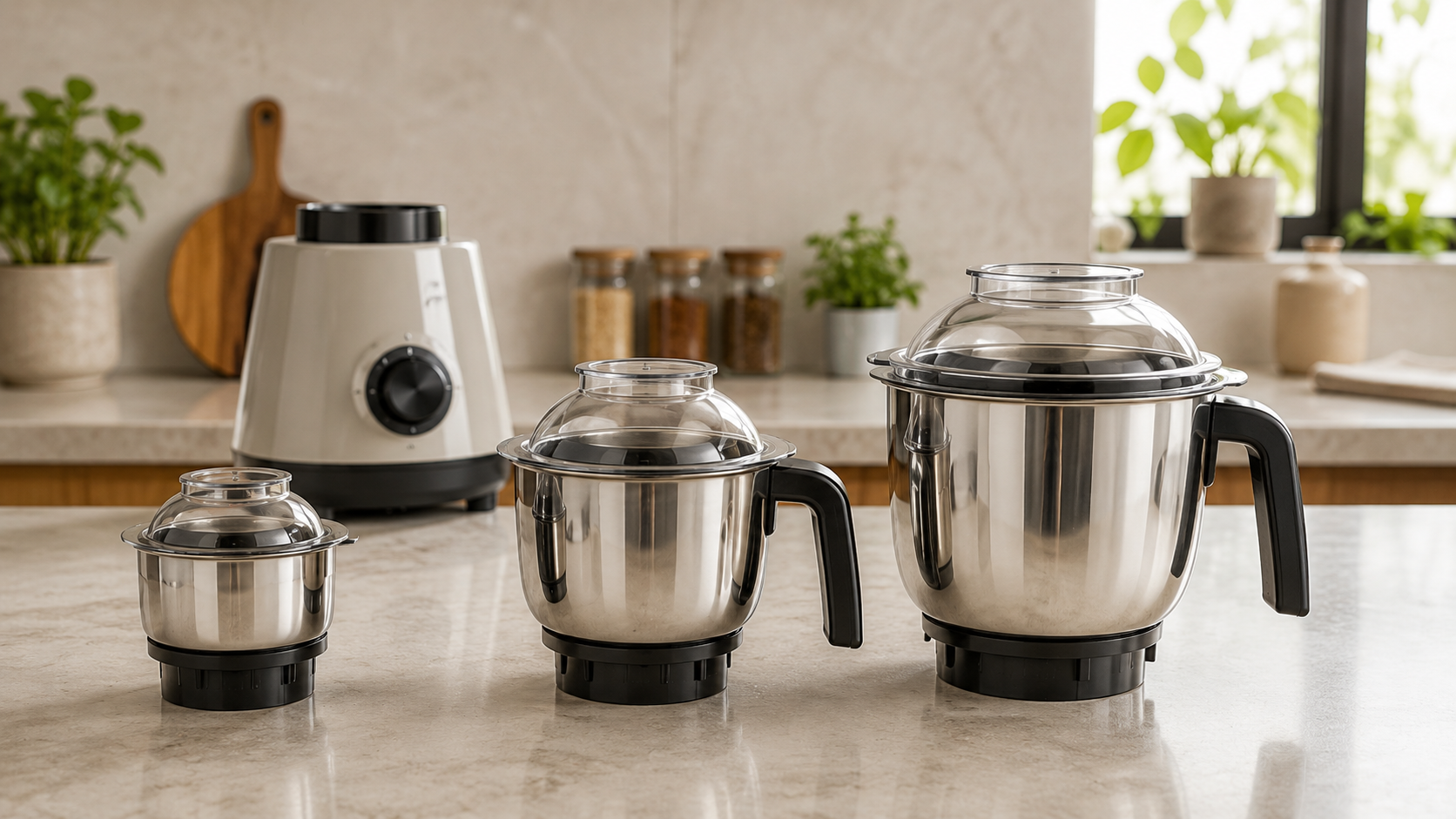
Bachelor
For light or occasional grinding, 750W can be more than adequate.
A 1000W model may be unnecessary unless you regularly prepare larger batches or do heavier grinding.
Couple
For two-person households with regular Indian cooking, a suitable 750W mixer grinder is often a practical option.
Small Family
Both 750W and 1000W can make sense.
The decision should depend on cooking frequency, batch size and the ingredients you regularly grind.
Large Family
A 1000W model may be worth considering when the household regularly handles heavier workloads or larger batches.
But family size alone does not determine wattage. A large family that cooks in small batches may not need 1000W.
8. Does 1000W Use More Electricity Than 750W?
A higher-rated motor can draw more electrical power while operating at its rated load, but your actual electricity consumption depends on how long and how often you use the appliance.
For example, if two motors were running continuously for 10 minutes at their rated wattage:
- 750W → approximately 0.125 kWh
- 1000W → approximately 0.167 kWh
The difference is about 0.042 kWh for that 10-minute period.
Real-world usage will usually be different because mixer grinders operate for relatively short periods and do not necessarily draw their rated power continuously.
So don’t choose 750W purely because you assume the electricity savings will always be substantial.
9. Does 1000W Mean Faster Grinding?
Not necessarily.
A higher motor rating can provide greater power capacity, but grinding speed and consistency also depend on:
- Ingredient hardness
- Batch size
- Jar shape
- Blade configuration
- Motor design
- Recommended operating conditions
A well-designed 750W appliance can therefore perform very well for everyday quantities.
The advantage of 1000W becomes more relevant when your actual workload is demanding—not simply because the number is higher.
10. Noise, Heat and Continuous Use
Noise and heat cannot be predicted from wattage alone.
They can be affected by:
- Motor construction
- Motor mounting
- Ventilation
- Appliance design
- Load
- Duration of each grinding session
So avoid assuming that every 1000W mixer grinder will be louder or hotter than every 750W model.
More importantly, follow the manufacturer’s recommended operating and rest periods. If you regularly grind for extended periods, check whether the specific model is designed for that workload.
11. 750W vs 1000W: Which Should You Buy?
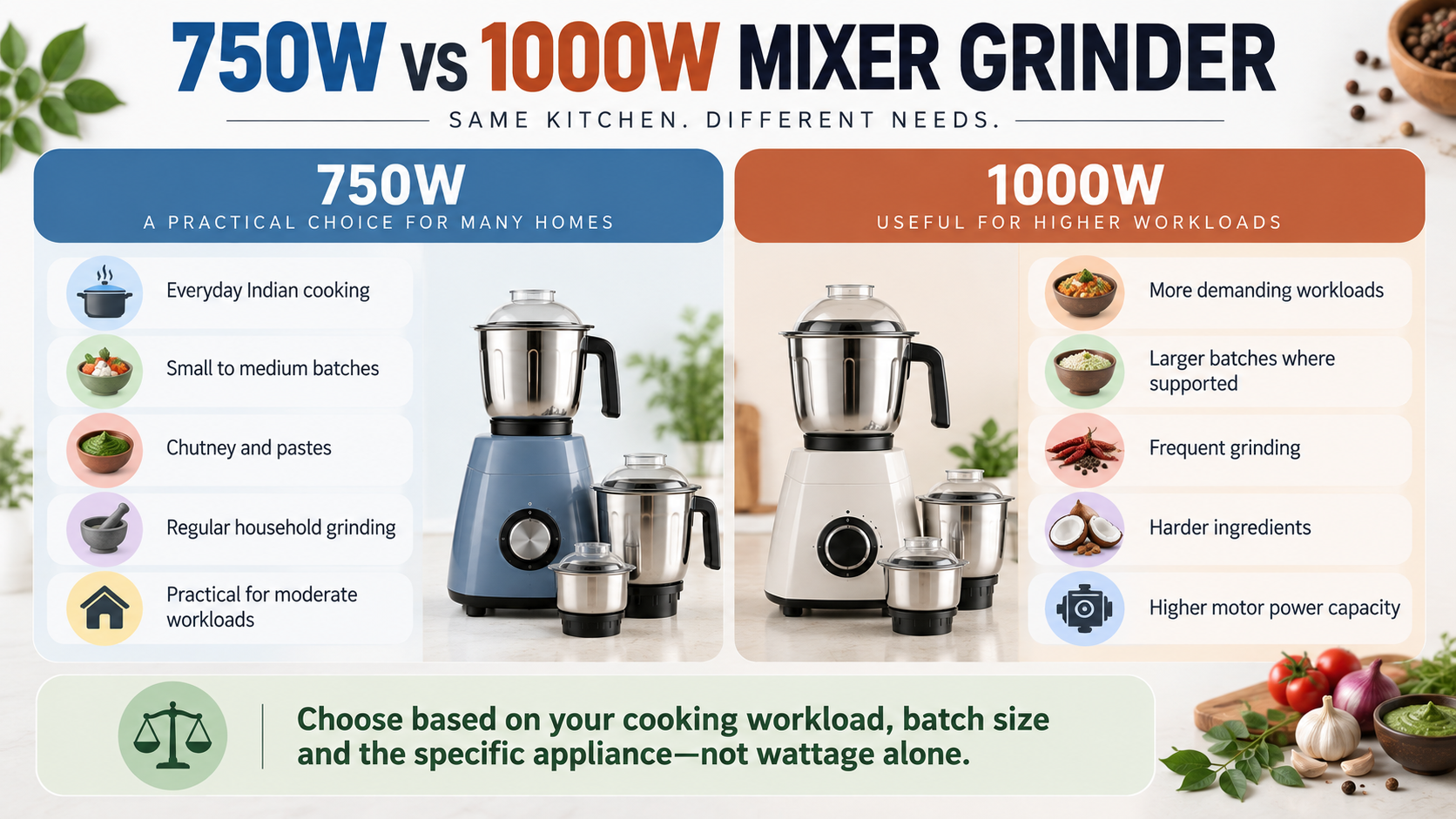
| If you mainly… | Consider |
| Make chutney and small batches | 750W may be sufficient |
| Prepare regular Indian meals | 750W is a practical option |
| Grind dry masala frequently | 750W–1000W depending on workload |
| Prepare larger batches | 750W–1000W depending on jar capacity |
| Grind frequently or heavily | Consider a suitable 1000W model |
| Have a small kitchen | Choose based on actual workload and storage |
| Want 1000W only because the number is higher | Don’t choose on wattage alone |
Simple rule
Moderate everyday cooking → start by considering 750W.
Frequent/heavier grinding → compare suitable 1000W models.
Then check the jar, blades, warranty and service support before making the final decision.
12. Examples of 750W and 1000W Mixer Grinders
These are examples for comparison, not a ranked list.
| Model | Wattage | Jars | Useful For | Warranty |
| Preethi Blue Leaf Diamond MG-214 | 750W | 3-jar configuration, variant dependent | Everyday Indian cooking | Verify current listing |
| Prestige Iris | 750W | Multi-jar configuration | Regular wet and dry grinding | Verify current listing |
| Philips HL7756 | 750W | 3 jars | Chutney, grinding and household use | Verify current listing |
| Sujata MG03 | 1000W | Includes wet-grinding jar | Heavier grinding and larger workloads | Verify current listing |
| Preethi Zodiac 2.0 | 1000W | Multiple jars/attachments | Broader household grinding requirements | Verify current listing |
| Bosch TrueMixx Pro | 1000W | Configuration varies by model | Dry grinding and heavier household use | Verify current listing |
Important: Product specifications, included jars and warranty terms can vary by exact model, variant and seller. Verify the current manufacturer’s/product listing before purchasing. The earlier draft specifically flagged some of these details for verification.
13. Frequently Asked Questions
Is 750W enough for Indian cooking?
For many households, yes. A suitable 750W mixer grinder can handle regular chutney, masala, pastes and moderate grinding tasks. Heavier workloads may justify considering 1000W models.
Is 1000W better than 750W?
Not automatically. A 1000W motor offers a higher rated power capacity, but the overall design of the appliance also affects real-world performance.
Does a 1000W mixer grinder consume more electricity?
It can draw more power while operating at its rated load, but actual electricity consumption depends on operating time and frequency.
Which is better for dry masala, 750W or 1000W?
Both can work. A suitable 1000W model may provide more power capacity for frequent or demanding dry grinding, while a well-designed 750W model can handle many normal household quantities.
Is 750W enough for dosa batter?
It can be suitable for moderate quantities when the model and jar are designed for the task. For larger or more frequent batter preparation, compare models with appropriate jar capacity and workload specifications.
Is 1000W necessary for a small family?
Not necessarily. Cooking frequency and batch size are more useful considerations than family size alone.
Does higher wattage mean faster grinding?
No. Grinding speed depends on the complete appliance design, ingredient, batch size, jar and blade configuration as well as motor power.
Should I buy a 750W or 1000W mixer grinder?
Choose 750W if your workload is moderate and mostly involves everyday quantities. Consider 1000W when your grinding is more frequent, demanding or involves larger batches supported by the specific model.
14. Final Verdict
Choose 750W if your cooking workload is moderate and you mainly prepare everyday Indian foods in normal household quantities. It can be a practical starting point for chutney, masala, pastes and moderate grinding.
Consider 1000W if your workload is genuinely heavier or more frequent, particularly when you regularly process harder ingredients or larger batches and the specific model is designed to support them.
The important takeaway is:
1000W is not automatically better than 750W.
Look at the motor, jar design, blade configuration, batch capacity, warranty and service support together. Match those features to your cooking habits rather than choosing the highest wattage simply because it is a bigger number.
Methodology
KitchenDeals comparisons are based on manufacturer specifications, current product information, warranty terms, intended use, current availability and other publicly available information. KitchenDeals does not claim hands-on testing unless explicitly stated.