As an Amazon Associate, I earn from qualifying purchases. This post may contain affiliate links. If you click and buy through these links, I may earn a small commission at no extra cost to you.
If you’re wondering whether a mixer grinder can actually handle idli and dosa batter properly, you’re asking the right question before you buy. The honest answer is: it depends on how much batter you make, how often you make it, and the texture you expect.
In this guide, we compare 7 mixer grinders for idli and dosa batter, based on manufacturer specifications, wet-grinding capability, jar design, motor power and warranty information.
Most importantly, this is not a “buy the highest wattage” guide. Motor wattage matters, but jar design, wet-grinding capability, continuous-running specifications and the manufacturer’s intended use are also important.
Kitchendeals tip: If you make batter only occasionally or in small quantities, a good mixer grinder can be a practical choice. If you regularly prepare large batches of batter and care strongly about traditional texture and fermentation, a dedicated wet grinder is usually the better tool.
A Note About Model Variants
Several brands sell closely related models under similar names. For example, Preethi has different Zodiac models, Prestige sells Iris and Iris Plus variants, and Bosch’s TrueMixx Pro range includes multiple model codes.
Always confirm the exact model number before buying, because specifications, included jars, warranty and pricing can vary between variants.
If you regularly prepare idli, dosa, chutney and other South Indian dishes, you may also find our guide to the Best Mixer Grinder for South Indian Cooking useful.
Quick Answer: Can a Mixer Grinder Make Idli & Dosa Batter?
Yes. A mixer grinder can grind soaked rice and urad dal into idli and dosa batter, particularly for small or occasional batches.
However, it isn’t a perfect replacement for a wet grinder when you’re making large quantities frequently. Wet grinders use a slower grinding mechanism that is specifically designed for wet grinding and large batter preparation.
Among the models reviewed here, Sujata Dynamix and Preethi Zodiac 2.0 (MG-255) stand out because their manufacturers specifically mention urad dal/rice or dosa-batter-related grinding.
For simpler, occasional use, models such as the Philips HL7756 and Preethi Blue Leaf Diamond are also worth considering based on their wet-grinding specifications
A mixer grinder used for batter can also be useful for everyday wet-grinding tasks such as coconut chutney. See our guide to the Best Mixer Grinder for Coconut Chutney.
Best Mixer Grinders for Idli & Dosa Batter — Comparison
| Mixer Grinder | Motor | Wet Jar | Saftey/Overload | Warranty | Best For |
| Sujata Dynamix | 900W | 1.5L Dome jar | Not explicitly specified | 2Y Product | Regular/frequent batter |
| Preethi Zodiac 2.0 MG-255 | 1000W | Verify | Overload protector | 2Y Product / 5Y Motor | Larger batches |
| Philips HL7756 | 750W | 1.5L | Not explicitly specified | 2Y Product / 5Y Motor | Small-medium batches |
| Preethi Blue Leaf Diamond MG-214 | 750W | 1.5L / 1.0L | Overload protector | 2Y Product | Flexible batch sizes |
| Prestige Iris | 750W | 1.5L | Overload protection | 2Y Product | General household use |
| Havells Hydro | 750W | 1.5L | Auto switch-off | 2Y Product / 5Y Motor | Easy cleaning |
| Bosch TrueMixx Pro | 1000W | Verify | Verify | Verify | Higher-power wet grinding |
Prices vary by seller and model code. Always check the latest selling price and exact model number before purchasing. Some specifications may differ between variants.
How We Selected These Mixer Grinders
We selected these models using manufacturer specifications and product descriptions, focusing on:
- Wet-grinding jar design
- Any explicit mention of idli/dosa or urad dal grinding
- Motor power
- Continuous-running information
- Warranty
- Safety features
- Jar capacity where available
There is an important difference between the models.
Sujata Dynamix and Preethi Zodiac 2.0 have explicit manufacturer information related to batter/urad dal grinding. The other models are included primarily because their wet-grinding systems are suitable for general wet grinding, which can reasonably extend to batter preparation.
Bosch TrueMixx Pro requires more caution because important details such as exact wet-jar capacity and warranty were not confirmed in the source research.
7 Best Mixer Grinders for Idli & Dosa Batter
1. Sujata Dynamix — Best for Regular Batter Grinding
The Sujata Dynamix stands out because its 900W motor is paired with a dedicated 1.5L Dome wet-grinding jar.
More importantly, Sujata’s product description specifically mentions grinding urad dal and rice for dosa, making this one of the clearest options for batter preparation.
Key Specifications
- 900W motor
- Double ball-bearing technology
- 1.5L stainless-steel Dome wet-grinding jar
- 3-speed rotary switch
- Whipper/pulse function
- 2-year product warranty
- Manufacturer states up to 90 minutes of continuous running
Why It Suits Batter
The dedicated Dome jar is designed specifically for wet grinding rather than being simply a general-purpose jar. The manufacturer also directly mentions urad dal and rice for dosa.
The stated continuous-running capability is another useful feature for households that prepare batter regularly.
Pros
- Explicit manufacturer claim for dosa batter grinding
- Dedicated wet-grinding Dome jar
- High 900W motor
- Long continuous-running capability stated by the manufacturer
Cons
- Motor warranty is not separately specified
- Overload protection isn’t explicitly labelled
- Plastic body rather than metal exterior
Best For
Families making idli/dosa batter regularly.
Verdict
If batter preparation is one of your main reasons for buying a mixer grinder, Sujata Dynamix is one of the strongest options in this list because of its dedicated wet-grinding jar and explicit manufacturer support for dosa batter grinding.
2. Preethi Zodiac 2.0 (MG-255) — Best for Higher-Power Grinding
The Preethi Zodiac 2.0 MG-255 uses a 1000W Sigma W2 motor and is different from the standard 750W Preethi Zodiac MG-218.
The manufacturer specifically mentions continuous urad dal grinding, which makes it particularly interesting for batter preparation.
Key Specifications
- 1000W Sigma W2 motor
- Wet-grinding jar capacity: verify before buying
- Overload protector
- LED power-safe indicator
- 2-year product warranty
- 5-year motor warranty
Why It Suits Batter
The manufacturer documentation specifies a 30-minute total rated operating time, while the manual limits continuous operation to 5 minutes followed by a minimum 2-minute rest is more directly relevant to batter preparation than a generic “wet grinding” specification.
However, this is still a manufacturer claim, not an independent test result.
Pros
- Explicit manufacturer claim for continuous urad dal grinding
- 1000W motor
- Overload protection
- LED safety indicator
- 5-year motor warranty
Cons
- Wet-grinding jar capacity needs verification
- Likely more expensive than simpler models
- More attachments can mean more storage and cleaning
Best For
Larger households that prepare bigger batches less frequently.
Verdict
A strong high-power option on paper, particularly because of its manufacturer-stated urad dal grinding capability. Confirm the exact jar capacity before buying.
3. Philips HL7756 — Best for Small to Medium Batches
The Philips HL7756 is a 750W mixer grinder with a 1.5L stainless-steel wet jar.
Philips specifically mentions grinding black whole gram for dosa and vada preparation and states up to 25 minutes of continuous grinding for tough ingredients.
Key Specifications
- 750W Turbo Motor
- 1.5L stainless-steel wet jar
- 3-speed control
- Pulse function
- 2-year product warranty
- 5-year motor warranty
- Manufacturer states up to 25 minutes of continuous grinding
Why It Suits Batter
The manufacturer specifically references grinding black gram for dosa preparation. The 1.5L wet jar makes it more appropriate for small to medium household quantities rather than very large batches.
Pros
- Manufacturer mentions dal grinding for dosa
- 25-minute continuous grinding capability stated by the brand
- 5-year motor warranty
- Compact design
Cons
- Overload protection isn’t explicitly listed in the reviewed specification
- Exact features may vary by variant
- Mild smell during initial uses may occur, according to the manufacturer
Best For
Small and medium households making batter a few times a week.
Verdict
A practical 750W option for regular but moderate batter preparation. Confirm the exact HL7756 variant before buying.
4. Preethi Blue Leaf Diamond (MG-214) — Best Flexible Jar Size
The Preethi Blue Leaf Diamond is interesting because its wet-grinding jar can be used at 1.5L or 1.0L capacity through its Flexi Lid design.
Key Specifications
- 750W motor
- 1.5L stainless-steel jar
- Convertible to 1.0L
- Overload protector
- Reset mechanism
- 2-year product warranty
Why It Suits Batter
The ability to adjust the jar capacity can be useful when your household makes different quantities of batter.
The manufacturer describes the jar as suitable for wet grinding and liquidizing, although it does not specifically name idli/dosa batter in the reviewed product description.
Pros
- Flexible 1.5L/1.0L jar
- Grind-and-store design
- Overload protection
- Established brand
Cons
- Motor warranty isn’t separately specified in the reviewed listing
- Manufacturer-listed operating noise is around 80dB
- No specific manufacturer claim for idli/dosa batter
Best For
Households that prepare different batch sizes.
Verdict
A flexible wet-grinding option for smaller households, but its batter suitability is based on general wet-grinding capability rather than a specific batter claim.
5. Prestige Iris — Best General-Purpose Option
Prestige’s mixer-grinder information states that its mixers are designed for wet grinding, including tasks such as making dosa and idli batter. This makes the Iris a reasonable general-purpose choice.
Key Specifications
- 750W copper motor
- 1.5L stainless-steel wet jar
- 3-speed control
- Pulse function
- Overload protection
- 2-year product warranty
Why It Suits Batter
The brand-level statement about dosa and idli batter provides useful support. However, it is not a model-specific claim for the Iris jar.
Pros
- Brand-level batter suitability
- Pulse function
- Widely available
Cons
- No dedicated batter-specific jar
- Some third-party reviews mention higher noise
- No large-batch-specific manufacturer claim
Best For
Small to medium households looking for one mixer grinder for general cooking and occasional batter preparation.
Verdict
A solid general-purpose option, but it isn’t as specifically designed for batter as the Sujata Dynamix. Also confirm whether you’re buying Iris or Iris Plus.
6. Havells Hydro — Best for Easy Cleaning
Havells Hydro focuses on wide-mouth jars and general wet grinding rather than making a specific idli/dosa batter claim.
Key Specifications
- 750W motor
- 1.5L stainless-steel liquidizing jar
- 304-grade stainless-steel blades
- Auto switch-off
- 2-year product warranty
- 5-year motor warranty
- Exact speed count: verify
Why It Suits Batter
The 1.5L wet jar and stainless-steel blades make it a reasonable option for general wet grinding. However, the manufacturer information reviewed does not specifically mention idli/dosa batter.
Pros
- Wide-mouth jar
- Easier cleaning
- 5-year motor warranty
- Flow-breaker design
Cons
- No explicit manufacturer claim for idli/dosa batter
- Auto switch-off should not automatically be assumed to mean overload protection
- Exact speed settings need verification
Best For
Buyers who value easy cleaning and also need occasional wet grinding.
Verdict
A reasonable general-purpose option, but batter suitability is inferred from its wet-grinding capability rather than directly claimed by the manufacturer.
7. Bosch TrueMixx Pro — Best for Higher Wattage and Wet-Grinding Blade
Bosch TrueMixx Pro models offer up to 1000W power and a detachable wet-grinding blade.
However, this range contains multiple model codes, and several important details weren’t confirmed in the available manufacturer information.
Key Specifications
- 1000W motor
- Detachable wet-grinding blade
- Dry-grinding blade
- Stone-pounding blade on applicable models
- 3-stage speed control
- Pulse function
- Wet-grinding jar capacity: verify
- Warranty: verify
Why It Suits Batter
The dedicated wet-grinding blade is relevant to batter preparation. However, Bosch’s reviewed information does not specifically mention idli, dosa or urad dal grinding.
Therefore, don’t assume that 1000W automatically makes it better for batter.
Pros
- 1000W motor
- Dedicated wet-grinding blade
- Multiple blade options
- Versatile grinding system
Cons
- Wet-jar capacity isn’t confirmed
- No explicit batter claim
- Warranty details need verification
- Higher price positioning
Best For
Buyers specifically interested in a higher-power mixer with a dedicated wet-grinding blade.
Verdict
An interesting high-power option, but it has more unconfirmed details than the other models. Verify the exact model code, jar capacity and warranty before buying.
Can You Make Idli & Dosa Batter in a Mixer Grinder?
Yes. A mixer grinder can grind soaked rice and urad dal into batter.
But there is an important distinction between:
“Can it make batter?”
and
“Is it the best appliance for my batter requirements?”
For small quantities, a mixer grinder can be practical. For large quantities prepared frequently, a wet grinder is generally more suitable.
Mixer Grinder vs Wet Grinder for Batter
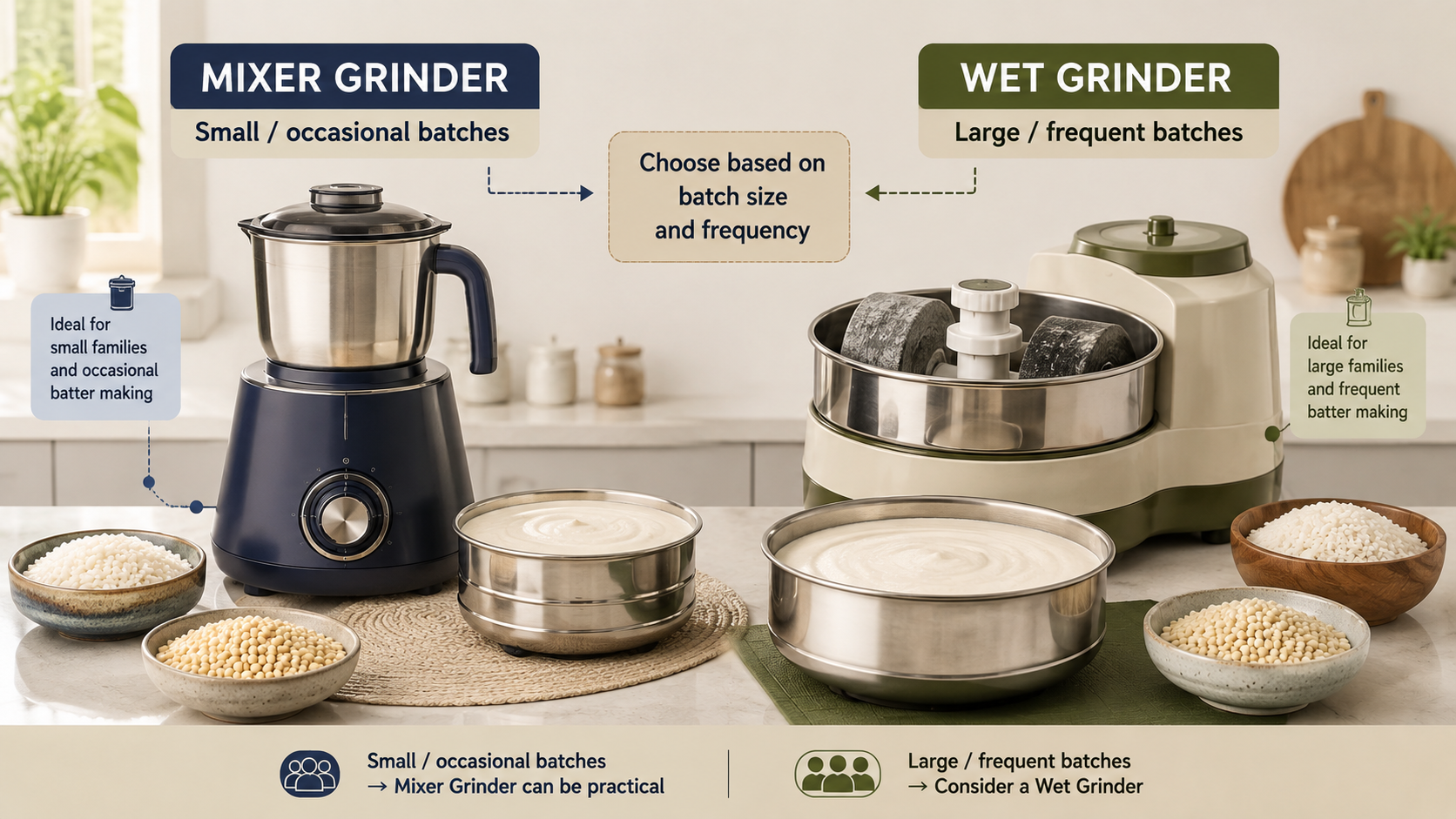
A mixer grinder uses fast-spinning blades to break down rice and dal.
A wet grinder uses heavy stones rotating at a much slower speed.
This difference affects the grinding process and heat generation. Faster blades can generate more friction heat, while wet grinders are designed around slower grinding.
Rather than focusing on a specific temperature number, the important point is that heat management matters during batter preparation because fermentation and final texture can be affected.
Choose a Mixer Grinder If:
- You make batter once or twice a week
- You make small batches
- You have limited kitchen space
- You want one appliance for chutney, masala and batter
- You don’t want a separate wet grinder
Choose a Wet Grinder If:
- You make large batches regularly
- You have a large family
- You are particular about traditional batter texture
- You prepare idli/dosa batter frequently
- You have enough space for another appliance
This is the most important buying decision in this article.
A mixer grinder is a practical space-saving option for small or occasional batter preparation.
A wet grinder is the more purpose-built option for frequent large-batch batter preparation.
500W vs 750W vs 1000W for Batter
Higher wattage does not automatically mean better batter.
500W
A 500W mixer grinder can work for occasional small-batch batter grinding, provided the jar and blade design are suitable.
750W
750W is a practical middle ground for many households. Several models in this comparison use 750W motors and are suitable for small to medium household use.
If you’re specifically looking for a 750W model, see our guide to the Best 750W Mixer Grinders.
1000W
1000W models provide more power headroom, but the important question is whether the jar and grinding system are designed to use that power effectively.
For example, the Preethi Zodiac 2.0 has a manufacturer-stated continuous urad dal grinding claim, while Bosch’s exact wet-jar capacity wasn’t confirmed in the research.
What About 900W?
The Sujata Dynamix is a good example of why wattage alone isn’t enough. Its suitability for batter comes from its dedicated Dome jar + explicit dosa-batter claim + stated continuous-running capability, not simply because it is 900W.
Not sure whether to choose 500W or 750W? See our guide to 500W vs 750W Mixer Grinders.
What to Check Before Buying a Mixer Grinder for Batter
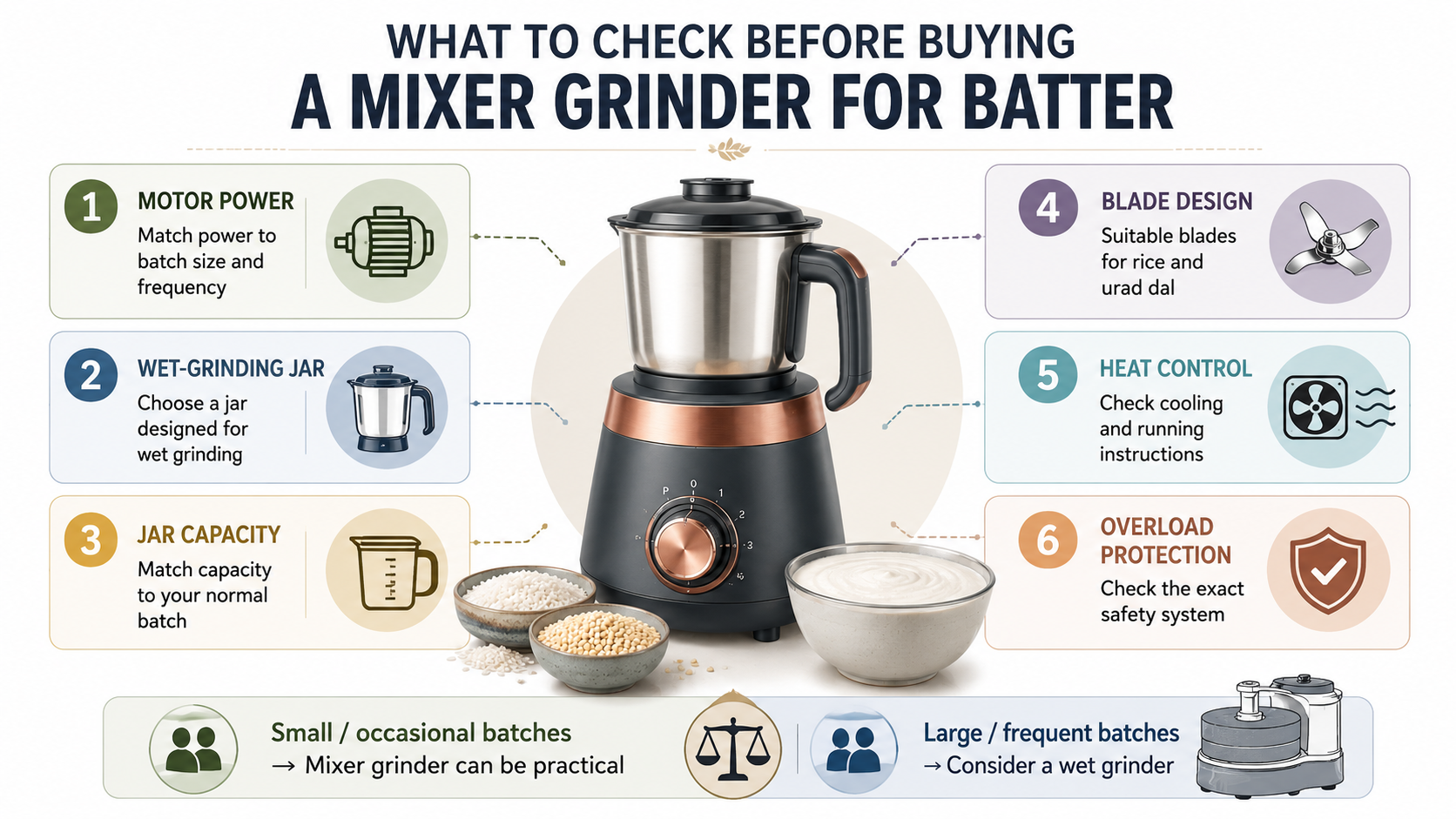
1. Motor Power
Match the wattage to your household size and frequency of use.
Don’t automatically choose the highest wattage.
2. Wet-Grinding Jar
Look for a jar specifically designed or marketed for wet grinding.
A dedicated wet-grinding jar is preferable when batter is an important use case.
3. Jar Capacity
Match the jar to your normal batch size.
A 1.5L jar can work well for small to medium households, but larger quantities may still require multiple batches.
4. Blade Design
Blade design matters because rice and urad dal need to be ground evenly.
Don’t evaluate the machine on wattage alone.
5. Heat Control
Look for manufacturer information about ventilation, cooling or continuous-running capability.
For example, Philips specifies continuous-running information, while Sujata recommends cooling breaks after prolonged use.
6. Overload Protection
Manufacturers use different terms such as:
- Overload protector
- Auto switch-off
- Safety cut-off
These aren’t necessarily identical systems, so check the exact model specification.
7. Speed and Pulse Control
Pulse control allows you to grind in short bursts, which can help with texture and heat management.
8. Cleaning
Batter can stick around blades and jar corners.
Wide-mouth jars and simpler lid designs can make cleaning easier.
How to Grind Rice and Urad Dal in a Mixer Grinder
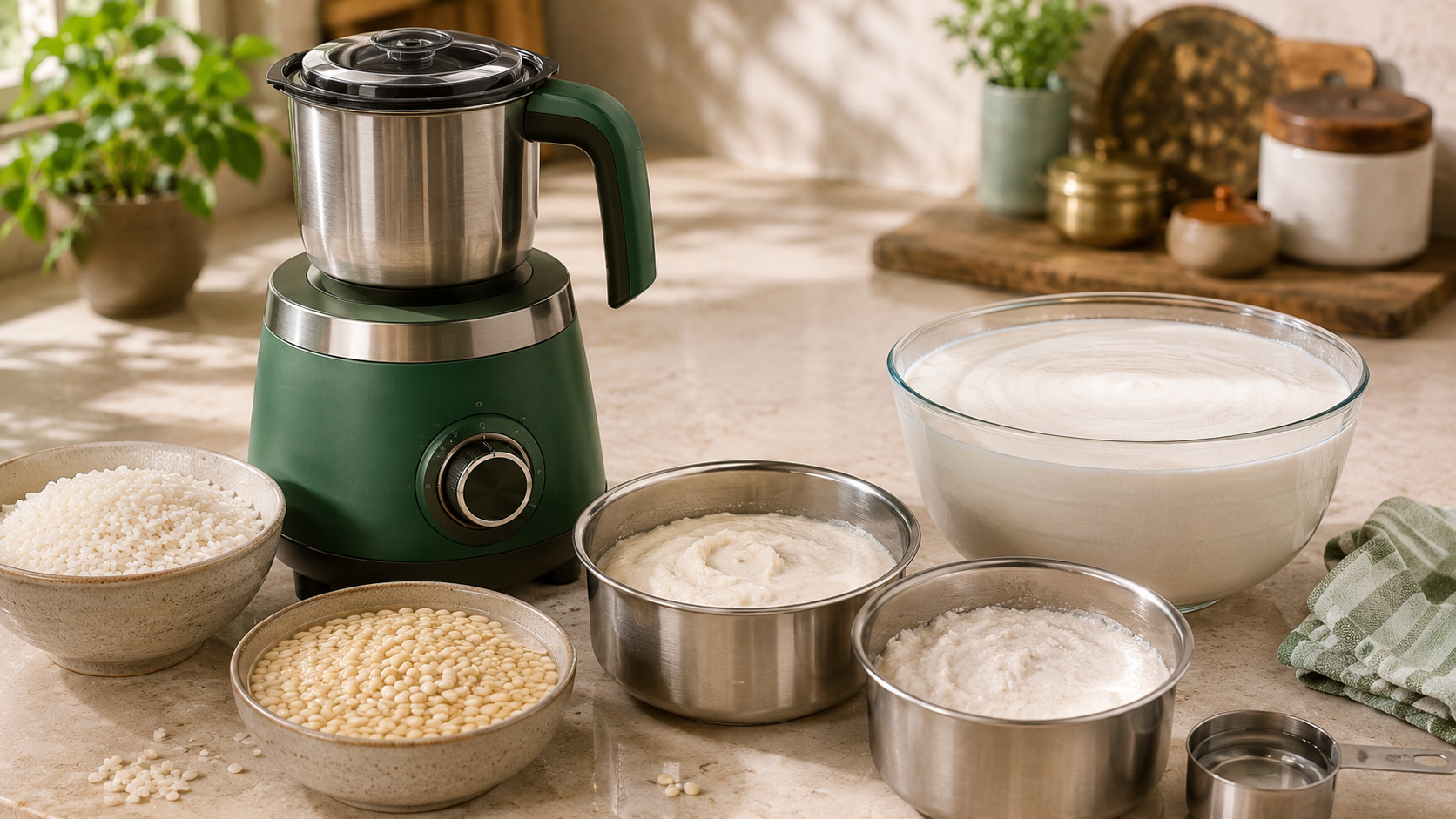
If you’re using a mixer grinder for batter, technique matters almost as much as the machine.
Step 1: Soak Separately
Soak rice and urad dal separately because they require different grinding consistency.
Step 2: Grind Urad Dal First
Grind the soaked urad dal first if that matches your preferred batter-making method, and aim for a smooth, light consistency.
Step 3: Grind Rice
Rice can be ground slightly coarser depending on the batter consistency you prefer.
Step 4: Add Water Gradually
Don’t add all the water at once. Add it gradually while grinding so you can control the consistency.
Step 5: Grind in Batches
Never force too much soaked rice or dal into a small jar.
If necessary, grind in multiple batches.
Step 6: Take Short Breaks
Use short grinding cycles with brief pauses to manage heat buildup.
Step 7: Allow the Motor to Cool
If you’re grinding multiple batches, allow the mixer motor to cool between batches.
Step 8: Combine the Batter
Once the rice and urad dal are ground, combine the batches and proceed with your normal fermentation process.
Common Batter Grinding Problems
Why Does Idli/Dosa Batter Become Hot?
Possible reasons include:
- Continuous grinding
- Overfilling
- Grinding too much in one batch
- Motor working under excessive load
What to do
Use shorter grinding cycles and allow breaks between batches.
Why Is My Batter Coarse?
Possible reasons:
- Insufficient soaking
- Too little grinding
- Overfilled jar
- Uneven blade contact
What to do
Soak properly and grind in smaller batches. Add water gradually rather than trying to grind everything at once.
Common Buying Mistakes
Avoid these mistakes:
- Assuming higher wattage automatically means better batter
- Ignoring the wet-grinding jar
- Choosing a large batch size without checking jar capacity
- Assuming every 750W/1000W motor performs the same
- Treating “wet grinding” as proof of batter-specific performance
- Ignoring overload protection terminology
- Confusing similar model variants
- Expecting mixer-grinder batter to behave exactly like wet-grinder batter
Who Should Buy a Mixer Grinder for Batter?
A mixer grinder makes sense if you:
- Live alone or in a small household
- Make batter occasionally
- Make small batches
- Have limited kitchen counter space
- Want one appliance for chutney, masala and batter
- Don’t want to purchase a separate wet grinder
Who Should Buy a Wet Grinder Instead?
A wet grinder is usually the better choice if you:
- Have a large family
- Make large quantities of batter frequently
- Prepare idli/dosa batter several times a week
- Care strongly about traditional batter texture and fermentation
- Have enough kitchen space for a dedicated appliance
Final Verdict
A mixer grinder can absolutely be a practical option for idli and dosa batter, especially when you’re making small or occasional batches.
Among the models reviewed here, Sujata Dynamix and Preethi Zodiac 2.0 stand out because their manufacturers provide more direct information about urad dal/dosa batter grinding.
For smaller or moderate household use, Philips HL7756 and Preethi Blue Leaf Diamond are worth considering for their wet-grinding capabilities.
The Bosch TrueMixx Pro is interesting because of its 1000W motor and dedicated wet-grinding blade, but important specifications need to be verified for the exact model.
If you’re shopping on a strict budget, you can also check our guide to the Best Mixer Grinder Under ₹4000.
The most important takeaway:
Small/occasional batter → a good mixer grinder can be practical.
Large/frequent batter → a dedicated wet grinder is usually the better choice.
Don’t buy a mixer grinder simply because it says 1000W.
Look at the wet-grinding jar, batch size, blade design, continuous-running capability and manufacturer specifications before making your decision.
And remember: no mixer grinder can guarantee a particular batter texture by itself. Soaking, water quantity, grinding time and heat management also matter.
Frequently Asked Questions
Can a mixer grinder really make idli and dosa batter?
Yes. A mixer grinder can grind soaked rice and urad dal into batter. However, results depend on the machine, jar design, batch size and grinding technique.
Is 750W enough for idli dosa batter?
For small to medium households, 750W can be sufficient when the mixer has a suitable wet-grinding jar. A 1000W motor may provide more power headroom, but higher wattage alone doesn’t guarantee better batter.
Why does my idli batter become coarse in a mixer grinder?
Insufficient soaking, short grinding time or overfilling the jar can result in coarse batter. Try proper soaking and smaller grinding batches.
Why does batter become warm in a mixer grinder?
Fast-spinning blades generate friction heat. Continuous grinding and overfilling can increase heat buildup. Short grinding cycles with pauses can help manage it.
How much rice and urad dal can I grind at once?
It depends on the jar capacity and the manufacturer’s operating instructions. Many models in this comparison use a 1.5L wet jar, but you should avoid overfilling and grind in multiple batches when necessary.
Is a wet grinder better than a mixer grinder for batter?
For large and frequent batches, a wet grinder is generally more suitable. For small or occasional batches, a good mixer grinder can be a practical alternative.
How long can I run a mixer grinder continuously for batter?
It depends on the exact model. Some manufacturers provide specific continuous-running claims. For example, the reviewed Philips information states 25 minutes and Sujata states up to 90 minutes. Always follow the operating instructions for your specific model.
Can I make dosa batter without a dedicated wet-grinding jar?
Yes, it may be possible with a suitable multipurpose wet jar. However, a dedicated wet-grinding jar can be preferable when batter preparation is an important part of your usage.