As an Amazon Associate, I earn from qualifying purchases. This post may contain affiliate links. If you click and buy through these links, I may earn a small commission at no extra cost to you.
1. The Short Answer
If your cooking regularly involves chutneys, spice grinding, wet masala or ginger-garlic paste, a mixer grinder is generally the more versatile choice for an Indian kitchen.
If your main requirement is smoothies, shakes, soups and other liquid-heavy recipes, a blender may be sufficient.
This is not an absolute rule. Some blenders include milling or grinding attachments, while some mixer grinders can handle smoothies and other liquid-based recipes reasonably well. The right choice depends on what you actually prepare most often, rather than simply choosing the appliance with the higher wattage.
2. What Is a Mixer Grinder?
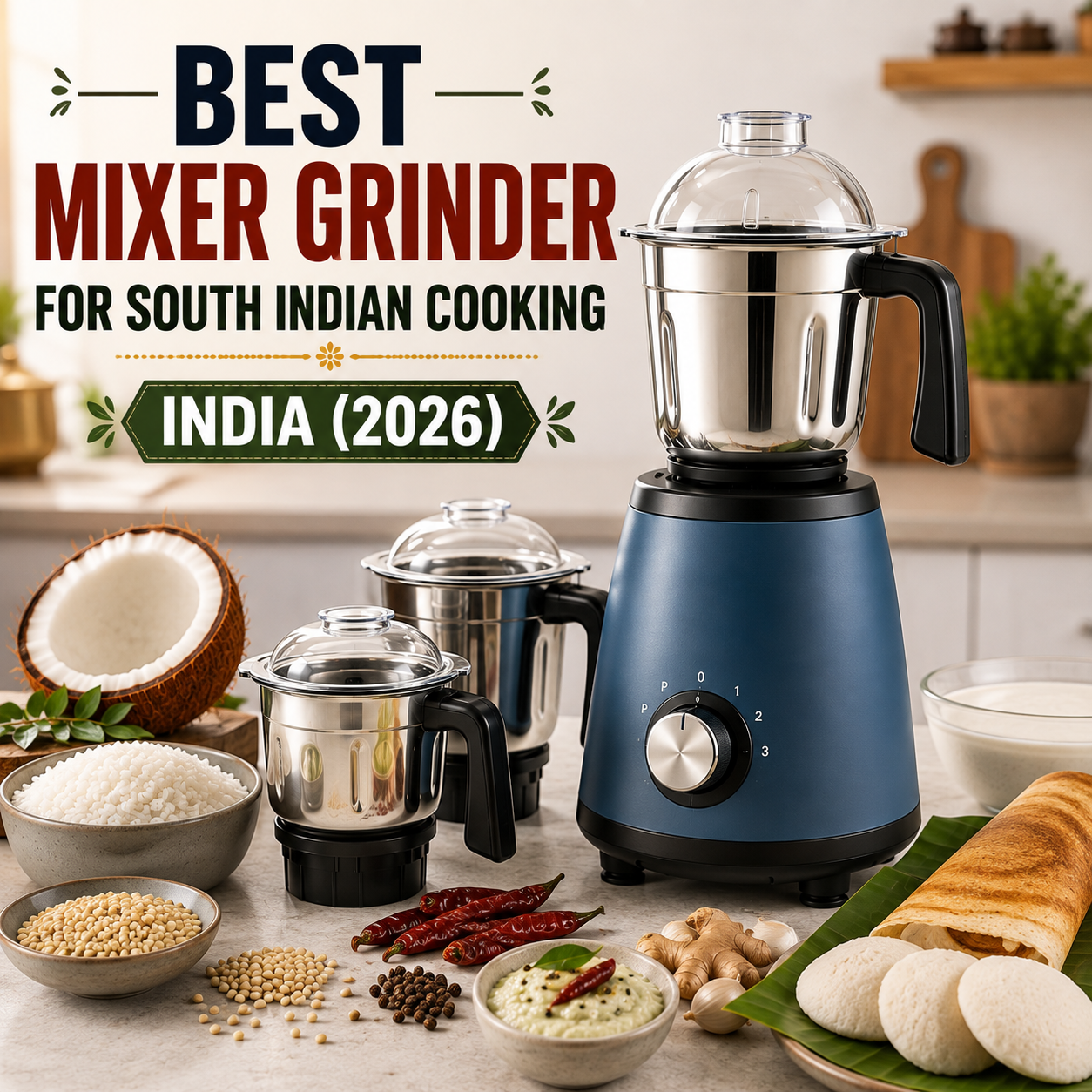
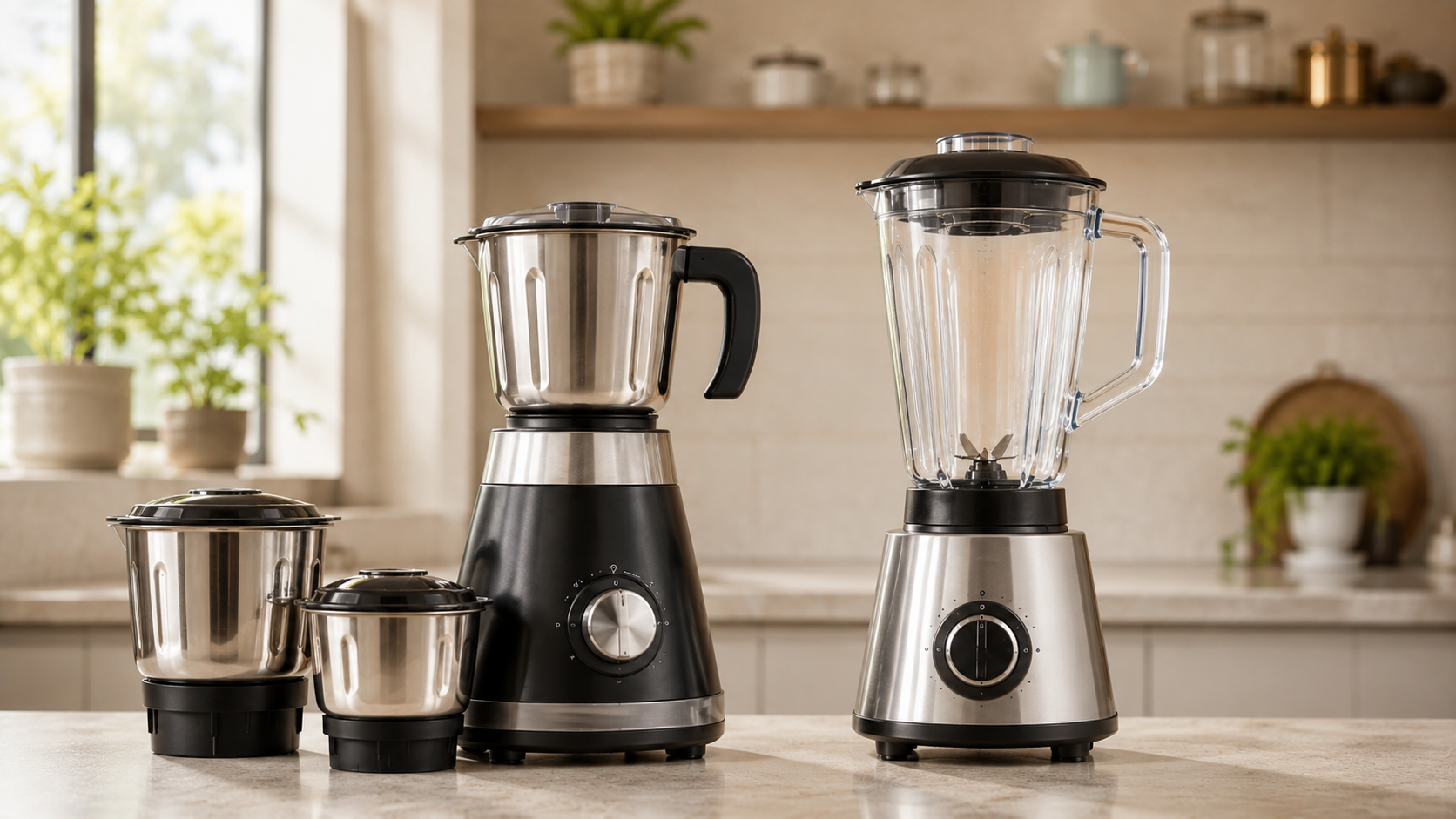
A mixer grinder is designed around multiple jars that can be used for different kitchen tasks. Common configurations include a wet-grinding jar, dry-grinding jar and smaller chutney jar.
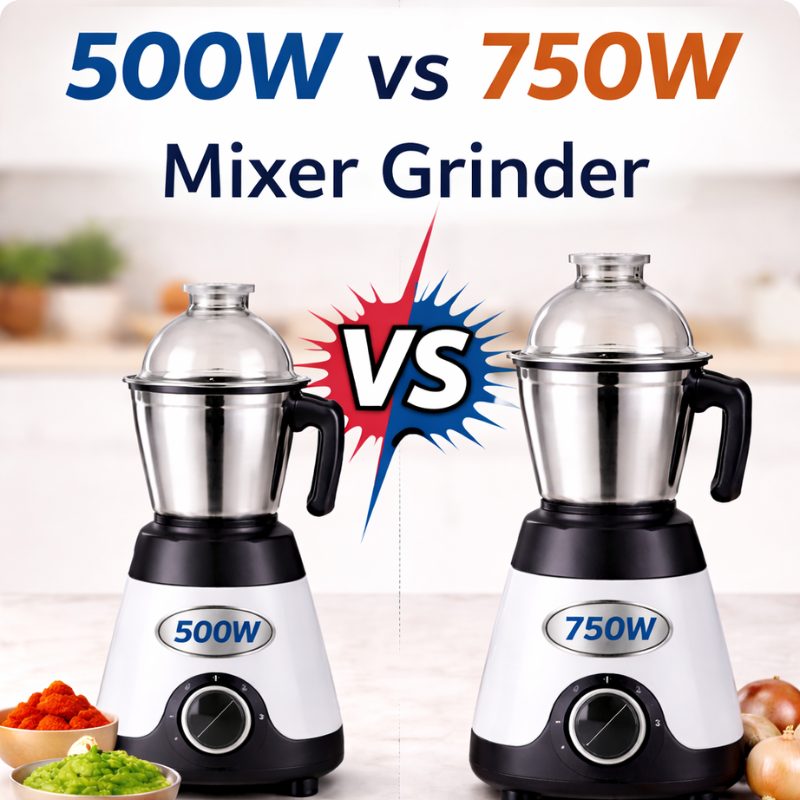
Indian mixer grinders are commonly available in different motor ratings, including 500W, 750W and higher-power models. The jar and blade configuration is important because many Indian cooking tasks involve relatively thick mixtures or small quantities of ingredients.
This makes mixer grinders useful for tasks such as:
- Coconut chutney
- Dry spice grinding
- Ginger-garlic paste
- Wet masala
- Small-batch grinding
- Some idli/dosa batter preparation
- Smoothies and other blending tasks, depending on the model
The exact capability varies between models, so always follow the manufacturer’s recommended use and operating instructions.
3. What Is a Blender?
A blender typically uses a taller jar with blades positioned at the bottom and is primarily designed for liquid-heavy mixtures.
Common blender uses include:
- Smoothies
- Milkshakes
- Soups
- Fruit blends
- Purees
- Other liquid-based recipes
Blenders vary considerably in motor power, jar design and blade configuration. Some models also include milling or grinding attachments for dry ingredients.
Therefore, you should not assume that every blender can perform the same tasks. Check the specific manufacturer’s specifications before using a blender for dry spices or other dense ingredients.
4. Mixer Grinder vs Blender: The Key Differences
| Feature | Mixer Grinder | Blender |
| Main purpose | Wet and dry grinding for many Indian cooking tasks | Liquid blending |
| Typical ingredients | Spices, coconut, ginger-garlic, dal and masala | Fruits, liquids, soups and shakes |
| Dry grinding | Usually available with a suitable jar | Depends on model and attachments |
| Wet grinding | Common function | Primarily designed for liquid-heavy mixtures |
| Chutney | Well suited with an appropriate jar | Possible, but suitability depends on jar and blade design |
| Spices | Suitable with a dedicated dry-grinding setup | Only if the manufacturer permits dry grinding |
| Smoothies | Possible, depending on model | Core use case |
| Liquid blending | Suitable for many everyday tasks | Primary strength |
| Jar design | Usually multiple jars for different tasks | Often one main blending jar |
| Blade design | Varies by jar and intended use | Designed primarily for blending and circulation |
| Batch size | Usually small to moderate depending on jar | Small to large depending on jar capacity |
| Cleaning | Multiple jars may mean more washing | Often simpler if there is only one main jar |
| Storage | More jars can require more storage | Often simpler if there is only one main jar |
| Best suited for | Indian cooking involving grinding and pastes | Smoothies, drinks, soups and liquid blending |
5. Which Is Better for Indian Cooking?
Coconut Chutney
A mixer grinder is generally more suitable for coconut chutney because many models include a smaller jar designed for relatively small quantities.
The exact result depends on the jar, blade design, ingredient quantity and amount of liquid used.
A standard liquid-focused blender may not be designed for the same type of thick, low-liquid mixture.
For more detailed guidance, see our Best Mixer Grinder for Coconut Chutney guide.
Ginger-Garlic Paste
Ginger-garlic paste is usually prepared in relatively small quantities and does not require a large amount of liquid.
A suitable small mixer-grinder jar can therefore be practical for this task.
A tall blender jar designed primarily for larger liquid-based mixtures may be less convenient for very small quantities.
Always follow the manufacturer’s recommended quantity and operating instructions.
Dry Masala
A mixer grinder with a dedicated dry-grinding jar is generally a more practical choice for regular spice grinding.
Typical ingredients include:
- Cumin
- Coriander seeds
- Black pepper
- Dry red chilli
- Fennel seeds
- Other dry spices
A standard blender should not automatically be assumed to be suitable for dry grinding. Some models include a milling attachment, so check the manufacturer’s instructions before using one for spices.
Wet Masala
Wet masala can involve thicker mixtures with relatively little liquid.
A mixer grinder with an appropriately sized wet-grinding jar can therefore be useful for this type of Indian cooking.
However, performance varies by model. Jar shape, blade design, ingredient quantity and operating time all affect the result.

Smoothies
This is an area where a blender may be the more natural choice.
Blenders are specifically designed around liquid circulation, which can be useful when preparing fruit smoothies, shakes and similar drinks.
A mixer grinder can also prepare smoothies depending on the model and jar design, so you do not necessarily need both appliances if smoothies are only an occasional part of your routine.
Soups and Purees
For liquid-heavy soups and purees, a blender may be more convenient, particularly when preparing larger quantities.
A mixer grinder can also handle many blending tasks, but the appropriate jar capacity and manufacturer’s instructions should be considered before processing hot or liquid-heavy mixtures.
Idli/Dosa Batter
A mixer grinder can be useful for small or occasional batches of idli/dosa batter.
If you prepare large quantities frequently, a dedicated wet grinder may be more suitable because it is specifically designed for wet grinding.
For a more detailed discussion, see our Best Mixer Grinder for Idli & Dosa Batter guide.
6. Can a Mixer Grinder Replace a Blender?
For many households, yes.
If you only occasionally make smoothies, shakes or purees, a mixer grinder may already cover most of your blending requirements.
However, the result depends on the particular mixer grinder. Jar capacity, blade configuration and the manufacturer’s intended use all matter.
When blending liquid-heavy ingredients:
- Do not exceed the recommended fill level.
- Follow the manufacturer’s instructions.
- Use the appropriate jar.
- Be especially careful with hot liquids.
- Process fibrous ingredients according to the appliance instructions.
If smoothies are a daily priority, a dedicated blender may still be worth considering.
7. Can a Blender Replace a Mixer Grinder?
Sometimes, but not always.
A basic liquid-focused blender may not be designed for:
- Dry spice grinding
- Thick chutneys
- Dense Indian masala
- Small quantities of low-liquid pastes
Some blenders do include milling or grinding attachments. If the manufacturer specifically supports those functions, they can cover additional kitchen tasks.
The important point is:
Do not assume that a blender can grind spices or thick pastes simply because it has a powerful motor.
Check the product documentation and intended use before buying.
8. Mixer Grinder vs Blender: Which One Should You Buy?

Choose a mixer grinder if:
- Indian cooking is your priority
- You regularly prepare chutney
- You grind spices at home
- You make ginger-garlic paste
- You prepare wet masala
- You want wet and dry grinding in one appliance
For wattage considerations, our 500W vs 750W Mixer Grinder guide can help you compare the two common power ranges.
Choose a blender if:
- Smoothies are a major part of your daily routine
- You mostly prepare liquid-based recipes
- Soups and purees are common in your kitchen
- You rarely grind spices
- You rarely prepare chutneys or thick pastes
Consider both if:
- You make smoothies or shakes very frequently
- AND
- You regularly grind Indian spices, chutneys and pastes
If both appliances will be used frequently, owning both can make sense.
If one of them would only be used occasionally, buying a second appliance may simply add cost, storage requirements and cleaning.
9. What About a Mixer Grinder + Blender Combo?
Buying both can make sense when the two appliances serve genuinely different daily purposes.
For example:
Morning: smoothie or shake in a blender
Lunch/dinner preparation: spices, chutney and masala in a mixer grinder
But buying both “just in case” may not be worthwhile.
Before purchasing a second appliance, ask:
- How often will I use it?
- Do I already have an appliance that can handle the task?
- Do I have enough counter space?
- Do I have storage space?
- Is the additional convenience worth the cost?
For a small kitchen, one well-matched appliance may be more practical than two appliances that are only occasionally used.
10. What About a Wet Grinder?
A wet grinder is a separate category from both a mixer grinder and a blender.
It is particularly useful for households that regularly prepare larger quantities of idli or dosa batter.
Wet grinders use a different grinding mechanism and are designed specifically for wet grinding. If batter preparation is only occasional, a mixer grinder may be more practical because it takes less storage space and can handle many other kitchen tasks.
If you regularly prepare large batter batches, see our Best Mixer Grinder for Idli & Dosa Batter guide for a comparison of mixer-grinder use versus dedicated wet grinding.
11. Buying Checklist
Before choosing between a mixer grinder and a blender, answer these questions:
1. What do I prepare most often?
Spices and pastes point toward a mixer grinder. Smoothies and liquid recipes may point toward a blender.
2. Do I need dry grinding?
If yes, check that the appliance and its specific jar are designed for dry grinding.
3. Is most of my cooking liquid-based?
If most of your recipes are smoothies, shakes, soups and liquid blends, a blender may be more suitable.
4. What batch sizes do I normally prepare?
Choose jar capacity based on your usual quantities rather than the largest available jar.
5. How often do I cook?
Frequent Indian cooking may justify a more versatile mixer grinder.
6. How much counter space do I have?
Remember that a mixer grinder with multiple jars also requires storage space.
7. Do I really need both?
If one appliance can handle most of your cooking, buying another may not provide enough additional value.
12. Frequently Asked Questions
Is a mixer grinder the same as a blender?
No. A mixer grinder is generally designed for a wider range of Indian wet and dry grinding tasks, while a blender is primarily designed for liquid-based blending. Exact capabilities vary by model.
Can a mixer grinder be used as a blender?
Yes, many mixer grinders can handle everyday blending tasks. However, results and liquid capacity vary by model, so follow the manufacturer’s instructions.
Can a blender grind spices?
It depends on the model. A basic blender may not be designed for dry spice grinding, while some models include a dedicated milling attachment. Always check the manufacturer’s specifications.
Which is better for coconut chutney?
A mixer grinder is generally the more practical choice because many models include a smaller jar suitable for chutney and other thick, small-batch preparations.
Which is better for smoothies?
A blender is generally the more natural choice for regular smoothies because its design is focused on liquid circulation and blending. A mixer grinder can also make smoothies depending on the model.
Can a mixer grinder make ginger-garlic paste?
Yes. Ginger-garlic paste is a common mixer-grinder task, particularly when using a suitable small jar and appropriate quantity.
Which is better for Indian cooking?
For most households that regularly prepare spices, chutneys, pastes and wet masala, a mixer grinder is generally more versatile.
However, households focused mainly on smoothies, shakes and liquid recipes may prefer a blender.
Do I need both a mixer grinder and a blender?
Not necessarily. If your blending requirements are occasional, a mixer grinder may be enough. Consider both only when you regularly need the different strengths of each appliance.
13. Final Verdict
There is no universal winner between a mixer grinder and a blender.
If Indian cooking is the main focus of your kitchen, a mixer grinder is generally the more versatile single appliance because it can handle tasks such as chutney, spice grinding, ginger-garlic paste and wet masala when the appropriate jar and settings are used.
If your kitchen is mainly about smoothies, shakes, soups and liquid-based recipes, a blender may be the better fit.
And if you regularly do both, buying both appliances can make sense — provided you have enough budget and storage space.
The simplest way to decide is to look at your actual weekly cooking:
More spices, chutneys and pastes → Mixer grinder
More smoothies, shakes and liquid blending → Blender
Regularly doing both → Consider both
Don’t buy based only on wattage, appearance or the number of features. Choose the appliance that matches the food you actually prepare.
Methodology
KitchenDeals comparisons are based on appliance design, intended use, manufacturer information and practical cooking requirements. Performance can vary by model, ingredients, quantities and usage conditions.
KitchenDeals does not claim hands-on testing unless explicitly stated.